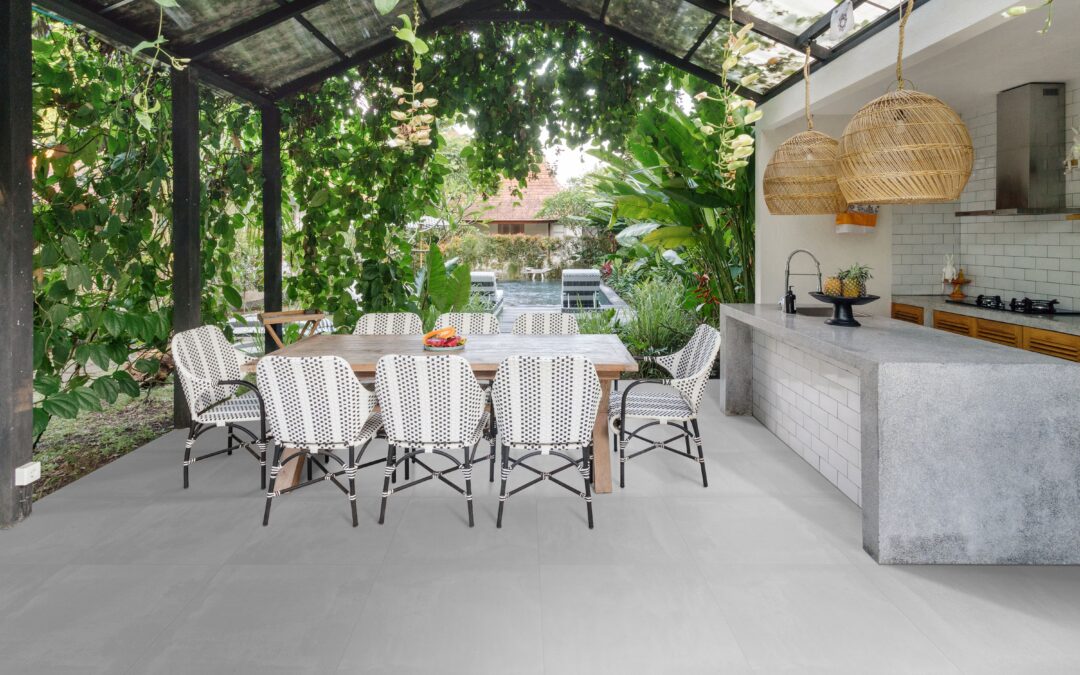
bathroom, blog, floors, kitchen
By Kurt Schou, Tiletoria consultant
You’ve seen the look, even if you didn’t know its name: floors that seem to run in one unbroken sweep from the front door to the back of the house, walls with barely a line on them, bathrooms that feel carved from a single piece of stone. That’s large format tiles at work — and if you’re planning a build or renovation, you’re probably wondering whether the look would work in your home, what it really costs, and what nobody’s telling you. Having spent years helping people answer exactly those questions on the showroom floor, here’s the honest version.
Table of Content:
What Counts as “Large Format”?
Why the Look Works
The Small-Space Myth
What It Really Costs
Why This Is Specialist Work — and the Questions to Ask Your Tiler
Will It Still Look Right in Ten Years?
There’s no official rulebook, but in practice any tile from 600×600mm upwards is considered large format. The workhorses of the category are 600×600 and 600×1200, and the range now stretches to 800×800, 1200×1200 and slab formats of 1200×2400 and beyond — single pieces bigger than a dining table. A decade ago, these were rare in South African homes; today they’re what most people picture when they imagine a modern floor.
Why the Look Works
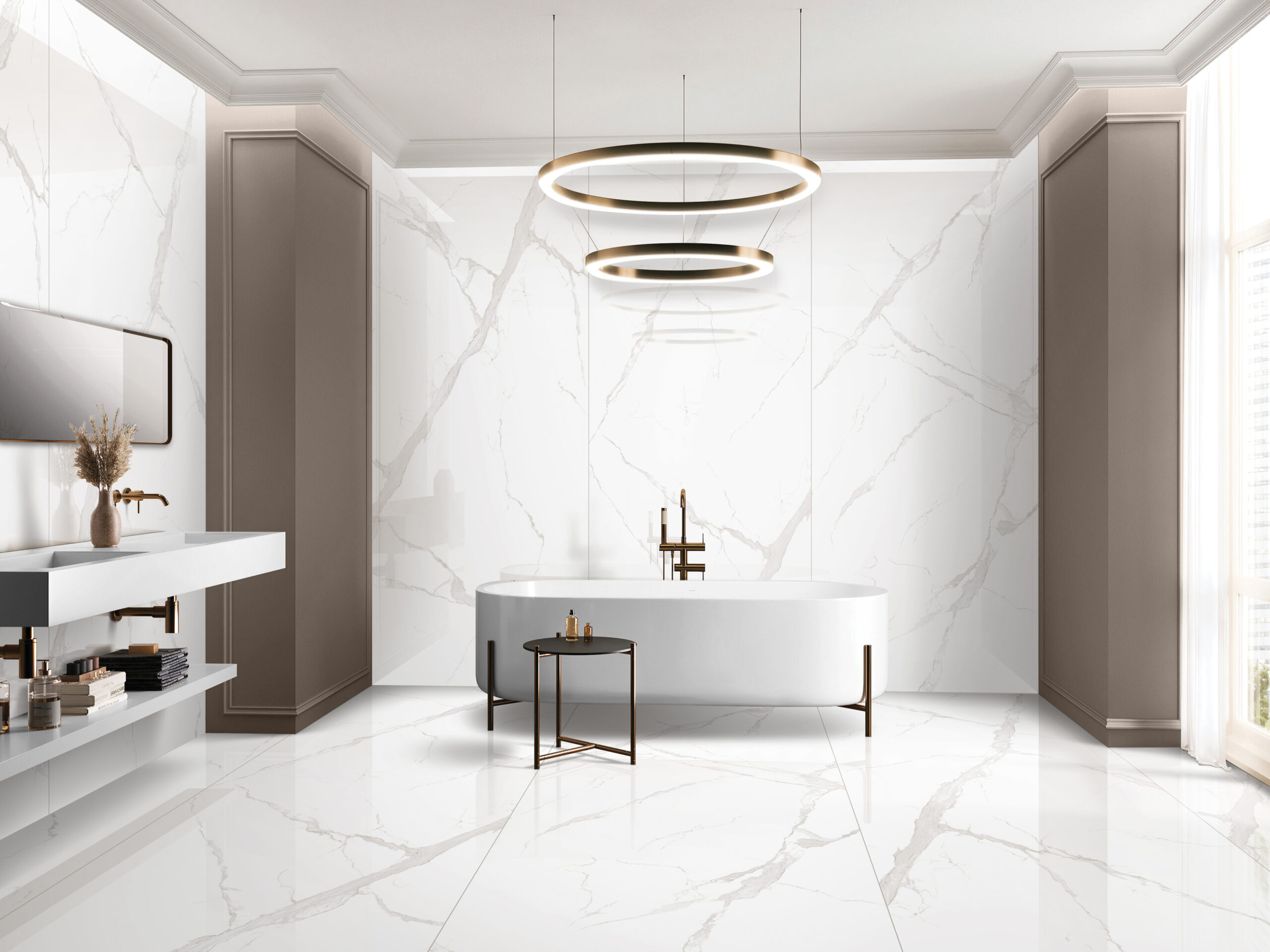
The magic is mostly about what disappears: grout lines. Fewer joints mean fewer visual interruptions, so a room reads as calmer and larger — the eye glides instead of counting squares. In open-plan homes, big tile flooring lets the kitchen, dining and living areas flow as one space instead of three, and running the same tile from inside to the patio makes even a modest home feel expansive.
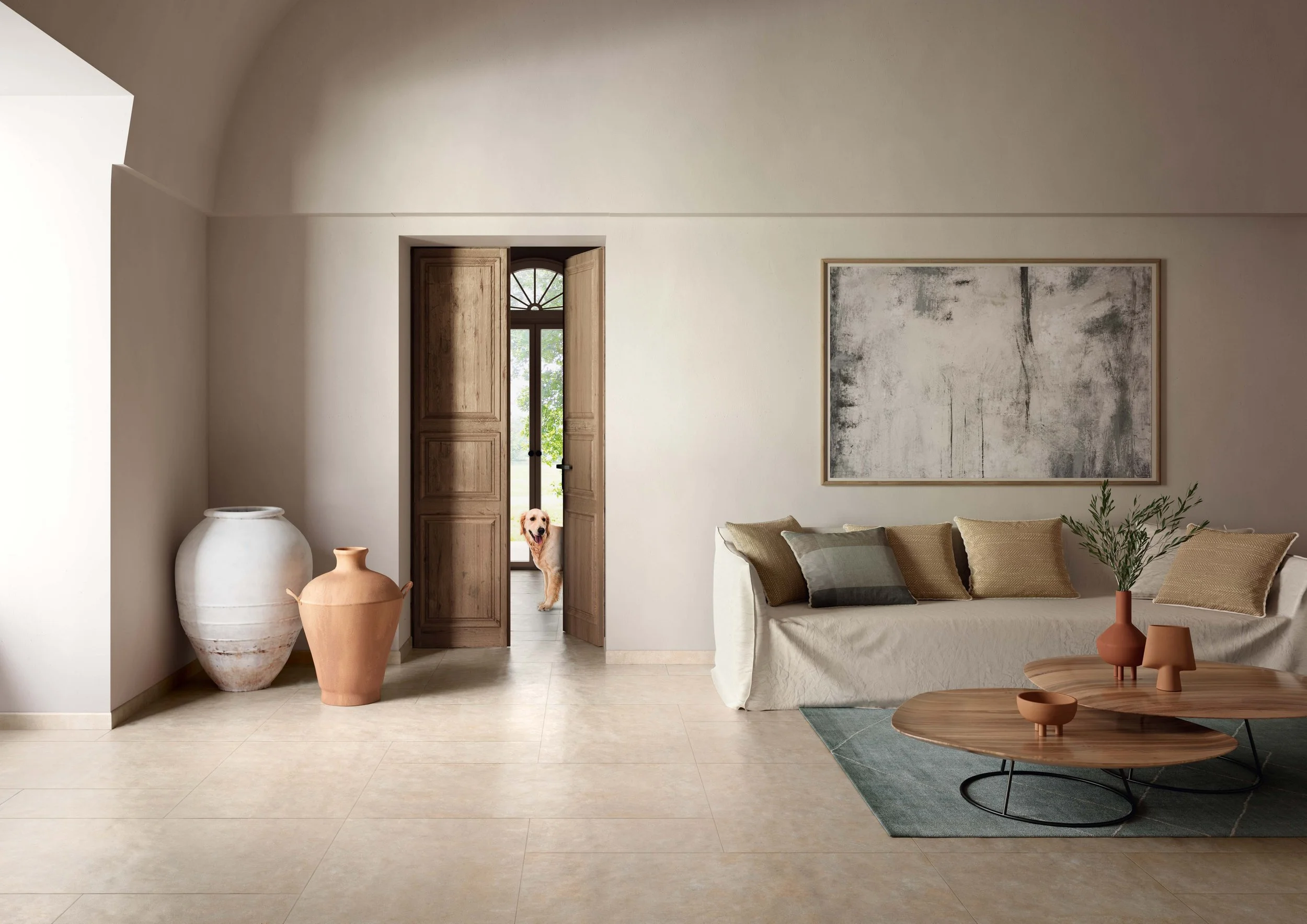
Fewer grout lines also mean less of the one part of a tiled floor that actually demands cleaning effort, which is why large format is as practical as it is fashionable for kitchen floor tiles.
The Small-Space Myth
The instinct says small room, small tiles. The showroom floor says otherwise. In a compact bathroom or entrance hall, a large tile with only a handful of joints makes the floor look bigger, not busier — it’s the grid of grout lines that shrinks a small space.
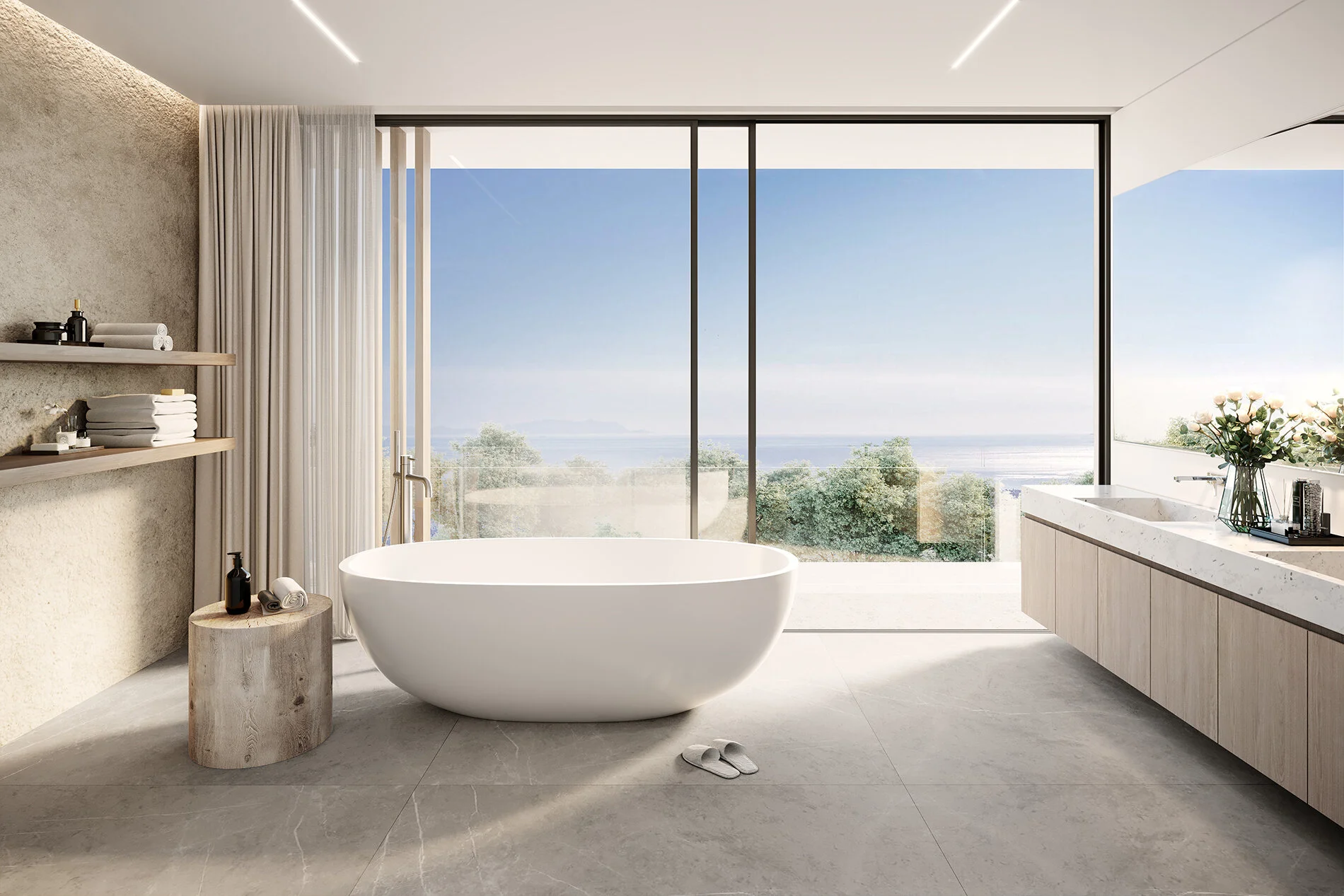
The real constraints in small rooms are practical, not visual: layout planning matters more, and falls to drains in bathrooms need thought. Done properly, some of the most convincing large-format rooms we see are the smallest ones.
What It Really Costs
Here’s the part that surprises people: the tile itself is often not much more expensive per square metre than a standard format — the difference sits in the preparation and the installation. Large tiles are unforgiving of an uneven floor, so the substrate may need levelling before a single tile is laid. They need more adhesive, applied correctly to the full back of the tile, and they take two people to carry and place.
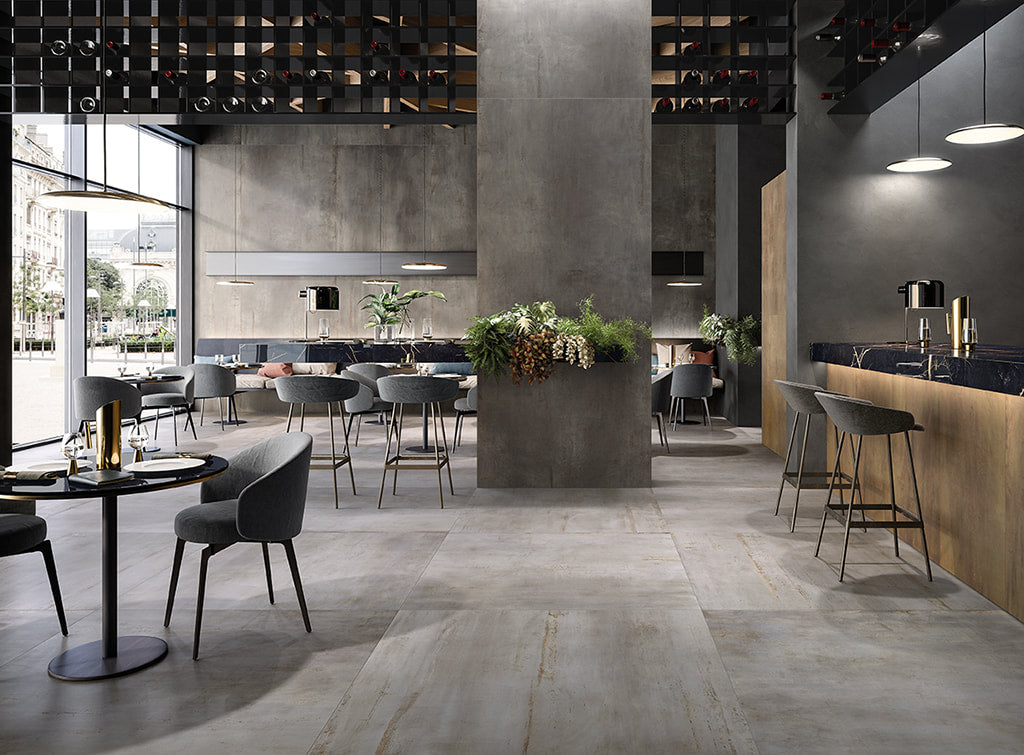
As a rough illustrative guide, budget for installation to cost noticeably more per square metre than standard-format work, and for surface preparation as a possible extra line item — your tiler can only quote it after seeing your floor. It’s money that buys a result standard tiles can’t deliver, but it belongs in the budget from day one, not as a surprise at quote stage.
Why This Is Specialist Work — and the Questions to Ask Your Tiler
This is the single most important thing to take from this guide: large format tiles are not a job for whoever is cheapest. A 1200×2400 slab handled wrongly cracks; a floor laid without a levelling system shows “lippage” — edges that catch your toe and your eye forever; adhesive spread thinly to save money leaves hollow spots that fail years later. None of this is visible on the day the tiler leaves. All of it is visible three years on.
So before anyone starts, ask three questions. Have you laid this format before — and can I see or call a past job? What levelling system do you use? And how will you prepare the substrate? A specialist answers all three without blinking. If the answers are vague, keep looking — in tiling, as in most things in a South African home build, the craftsman matters as much as the material. (We’re happy to point you toward tilers who work in these formats regularly; it’s a question our consultants answer every day.)
Will It Still Look Right in Ten Years?
Fair question — nobody wants this decade’s avocado bathroom. Our view, from decades of watching trends arrive and leave: large format is a shift, not a fad. It’s driven by how homes are now built and lived in — open plans, indoor-outdoor living, less time for maintenance — rather than by a colour or a pattern that dates.
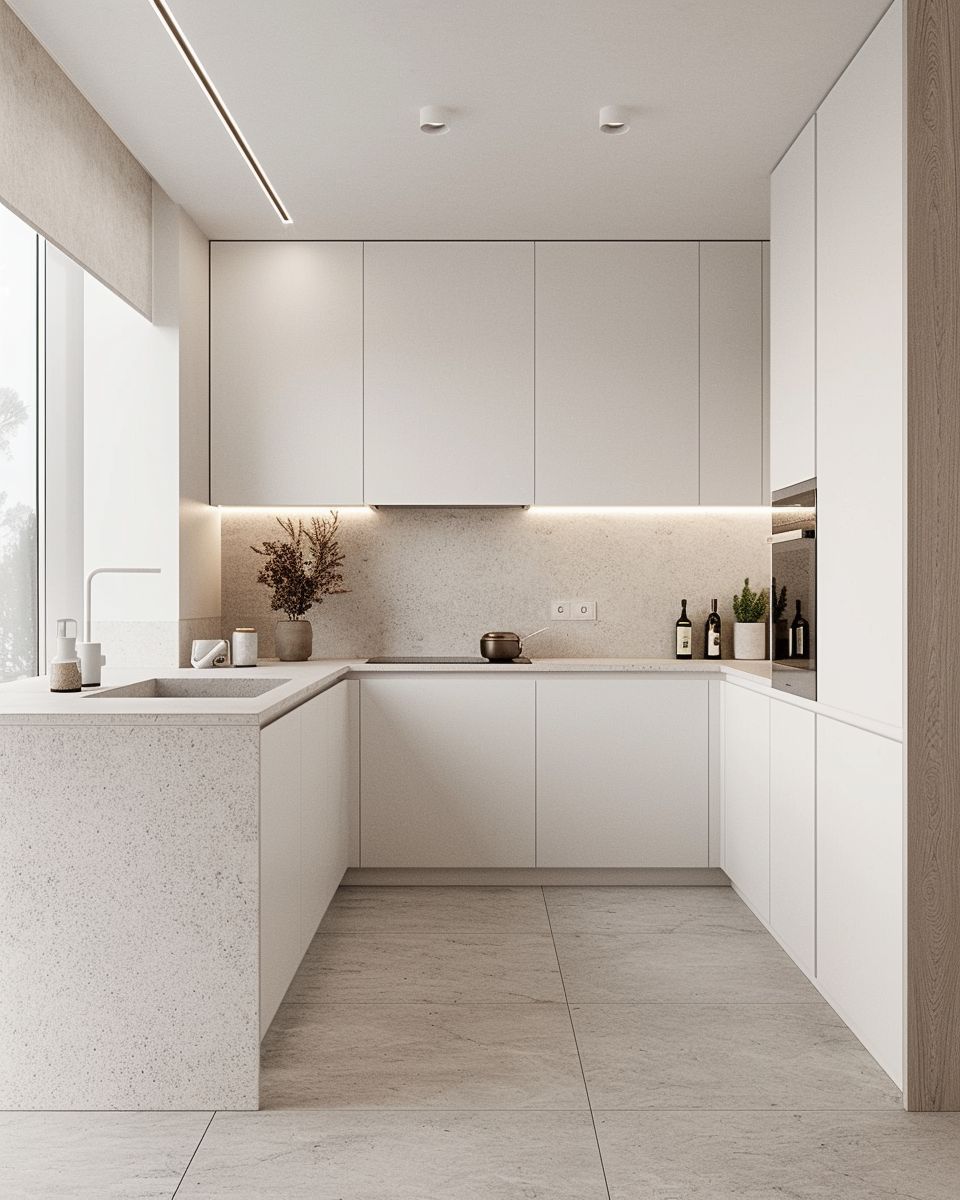
Choose a calm surface in a quality porcelain and you’re making one of the safer long-term choices in tile in South Africa right now; the durability does the sustainability work, and the format does the beauty work.
The best way to decide is to stand on it. Photographs flatten large format — you need to see a 600×1200 floor at full scale to understand what it does to a room. Visit a Tiletoria showroom, walk the displays, and talk the layout of your actual rooms through with a consultant. Bring your floor plan; we’ll bring the judgement.
blog, floors, kitchen
If you’re about to spend money on a new floor, you’re probably doing what most of us do: comparing prices per square metre. It’s the number on every shelf label and every quote, and it feels like the whole story. It isn’t — because a surface doesn’t stop costing you when you’ve paid for it. Ask most South Africans what makes a home greener and they’ll mention solar panels or a rainwater tank; almost nobody mentions what’s underfoot.
Yet the surfaces in a home carry both a cost story and a sustainability story, and they’re the same story. The most sustainable surface is the one you never have to replace.
Table of Content:
The Hidden Cost of the Replacement Cycle
Why Porcelain Lasts
Low Maintenance Is Low Impact
Do the Maths in Years, Not Square Metres
Durability Only Pays If You Choose Right the First Time
The Hidden Cost of the Replacement Cycle
Every floor and wall finish has two costs: the one you pay at the till, and the one it accumulates over its life. A surface that needs replacing every eight or ten years doesn’t just cost you again in rands — it costs again in manufacturing, transport, installation and rubble. Softer finishes that scratch, swell, fade or lift start that cycle early, and every cycle ends the same way: in a skip.
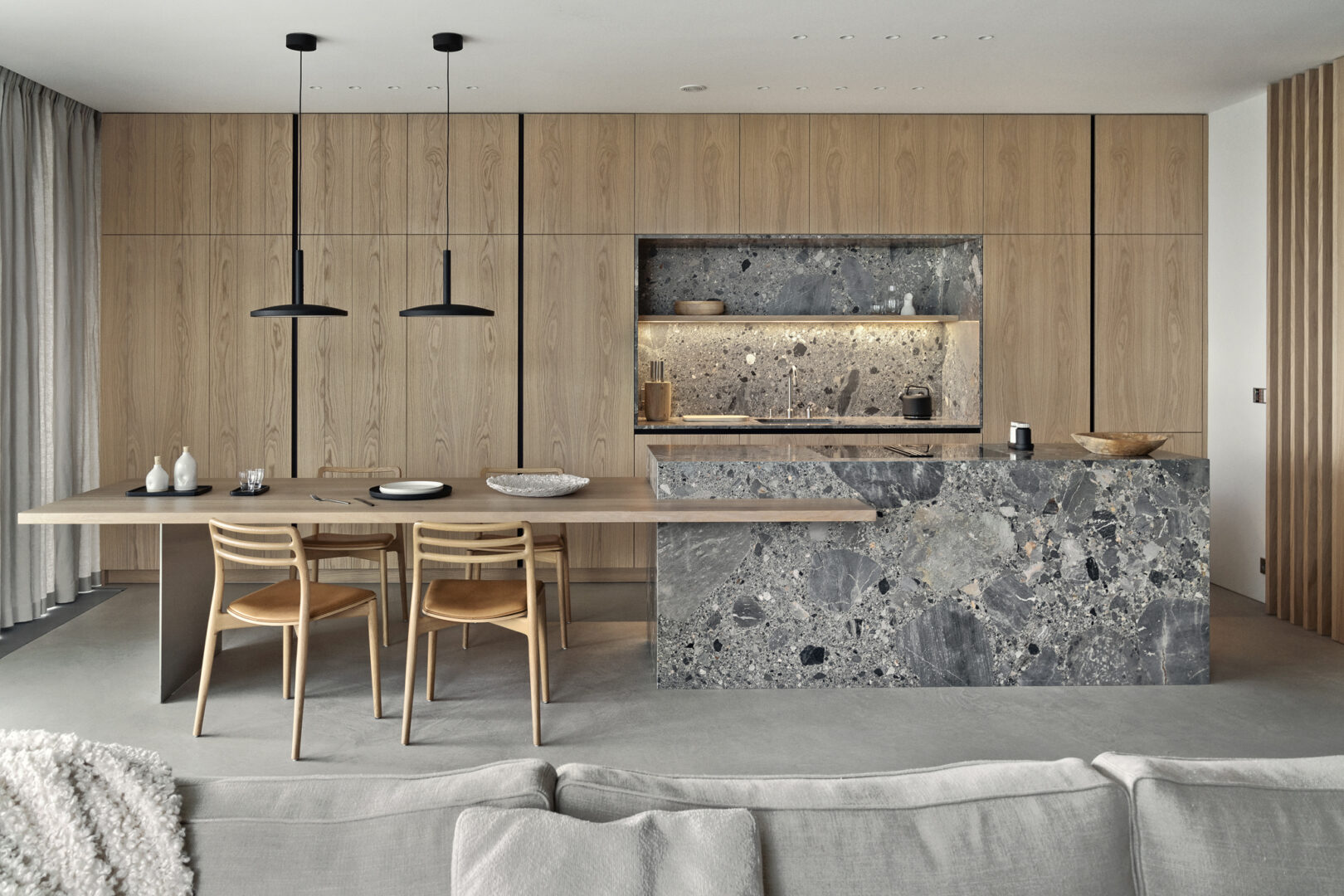
Tiles work on a different clock. A scenario our consultants know well: a family renovating a 1990s house strips out the kitchen for the second time in the home’s life — new cupboards, new counters, new appliances — and the one thing that stays is the original porcelain floor, because after nearly thirty years of school shoes, dogs and dinner parties there is still nothing wrong with it. Two kitchens have come and gone; the floor has outlasted them both. When a surface lasts that long, its footprint is spread across a lifetime rather than a decade. That is what sustainability looks like in practice, not on a label.
Why Porcelain Lasts
Porcelain is fired at extremely high temperatures until it becomes dense, hard and almost completely non-porous. In practical terms, that means it doesn’t fade in the harsh South African sun, doesn’t swell or warp when things get wet, and shrugs off the scratches that end the life of softer floors.
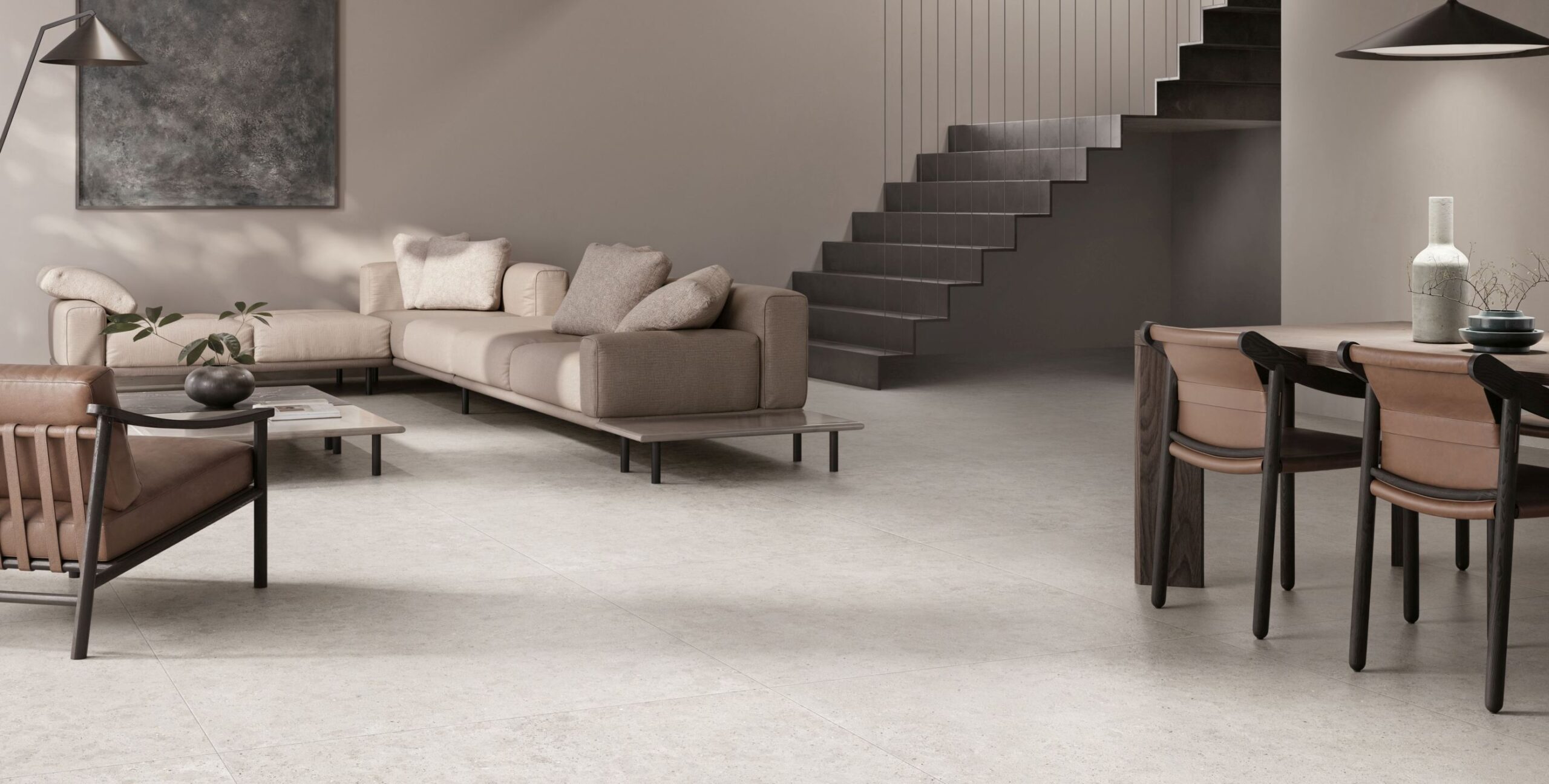
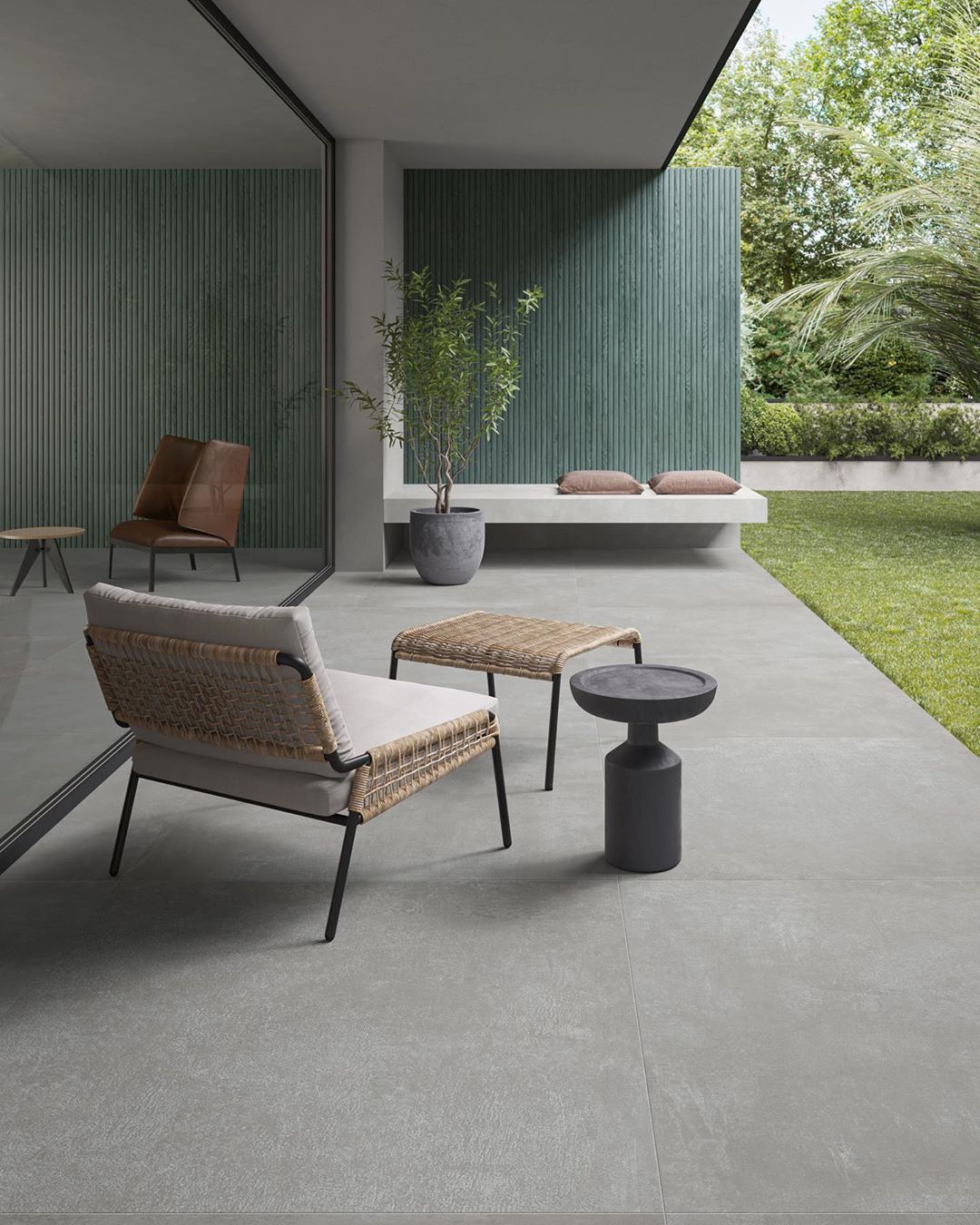
It matters most in the rooms that work hardest. Kitchen floor tiles take dropped pots, dragged chairs, spills and daily traffic for years without complaint, and kitchen wall tiles behind a hob will still wipe clean long after painted surfaces have surrendered. Outdoors, the right non-slip tiles handle sun, rain and pool water season after season — conditions that send most other surfaces to an early replacement.
Low Maintenance Is Low Impact
Durability is only half of the whole-life story. The other half is what a surface demands from you along the way. Tiles need no varnishing, no sealing (in the case of porcelain), no harsh chemical treatments and no specialist care — warm water and a standard cleaner keep them looking as they did on day one. Over twenty or thirty years, that’s a meaningful saving in chemicals, water and money, and it’s a form of sustainability that rarely makes the brochure.
Do the Maths in Years, Not Square Metres
Price is where the durability argument becomes a budgeting argument. When you compare ceramic tile prices with cheaper short-life alternatives, the per-square-metre number only tells you what day one costs. The better question is what a surface costs per year of service.
Take an illustrative example. A quality porcelain floor at R350/m² that serves for 30 years costs you under R12 per square metre per year. A budget surface at R180/m² looks like the smarter buy — until it needs replacing every ten years. Over the same 30 years that’s three rounds of material at R540/m², plus two extra rounds of installation, rubble removal and living through the mess. The “expensive” floor ends up costing roughly a third less per year of service, and that gap widens once labour is counted. (The numbers are illustrative, but the maths holds at almost any price point.)
Buying tile in South Africa on day-one price alone is how homes end up in the replacement cycle. Do the maths in years, and a different shelf in the showroom starts making sense.
Durability Only Pays If You Choose Right the First Time
There is one honest caveat: a surface that lasts forty years is only a blessing if it’s the right surface. The wrong tile — wrong rating for the space, wrong format for the room, a trend that dates in five years — lasts just as long.
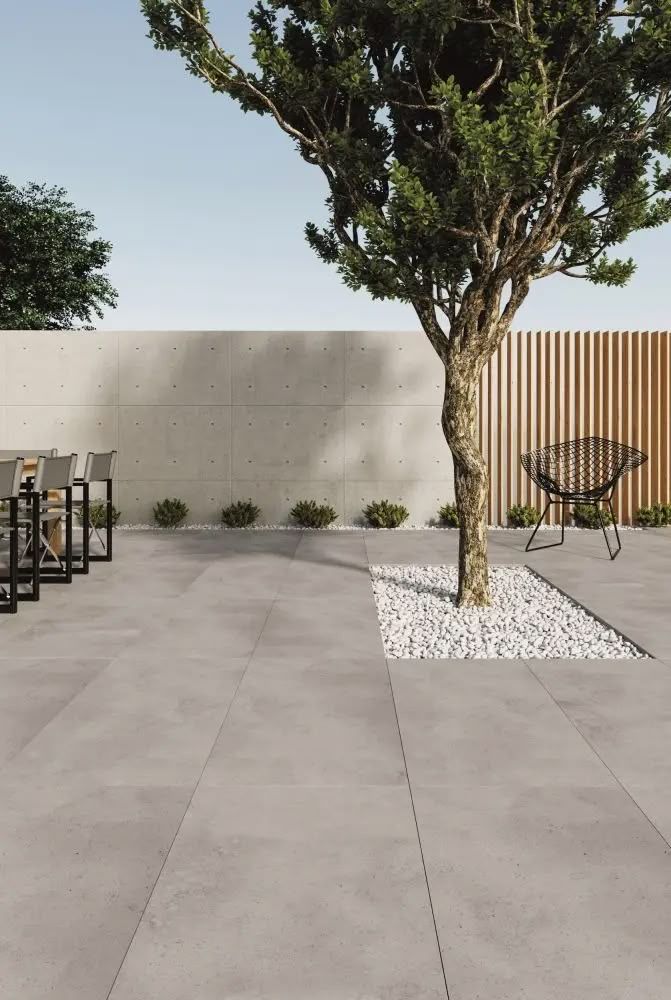
That’s where judgement earns its keep. Large format tiles — the big tile flooring look that suits today’s open-plan living — mean fewer grout lines to maintain, but they ask more of the installation. Outdoor and bathroom spaces need the right slip rating, not just the right look. And some colours and patterns will still feel right in 2046, while others won’t survive the decade. Knowing the difference is what decades of helping South Africans choose surfaces teaches — the kind of pattern recognition you can’t get from a product page.
So if you’re renovating with sustainability in mind — or simply with your budget in mind — start underfoot. Choose a surface built to last, choose it with advice you trust, and choose it once. Bring your plans into a Tiletoria showroom and talk it through with a consultant; the most sustainable decision you make this year might be the one you never have to make again.

case studies/renovation projects, how to articles, trends
Compared with residential floors, commercial flooring spaces usually face more demanding conditions, as they experience much higher traffic and potentially face serious legal threats when accidents occur. While ceramic and porcelain tile floors are great for durability and functionality, taking care of them in a commercial environment such as a restaurant, public bathroom or highly trafficked walkway can be challenging.
Here are the five biggest issues that businesses and property managers face in maintaining their tile floors. Keep this in mind when advising on tiles and grout for shops, hotels, restaurants and other commercial spaces.
Dirty Grout
 Stained grout is one of the most common grout issues in commercial settings, particularly in bathrooms and in restaurants where spills from food, oils and other contaminants are common. Due to the porous nature of grout and the fact that it is recessed below the surface of the tiles, it is both difficult to get to and can retain bacteria that sits beneath the surface.
Mops only move bacteria around and in bathrooms, bacteria feeds on urine and spreads. A Harris Interactive poll found that 79 percent of customers would not return to an establishment with a bathroom that they consider to be dirty. The numbers aren’t much better for dirty floors in other areas and these numbers do not account for the loss of reputation associated with unclean tile floors.
Bacteria and dirt trapped in grout lines not only looks bad but can retain unpleasant odors from spoiled foods, urine and unhygienic bacteria. Many cleaning solutions do not fully clean grout lines and can create additional discoloration as well as permanent damage. Hygiene concerns associated with this harmful bacteria are particularly a concern for health care facilities, restaurants and schools.
Stained, Discolored or Dirty Tiles

When tiles are porous, they will usually stain, most often, permanently. Textured tiles will retain ground dirt in the surface of the tiles. Some cleaning products and processes can assist with managing the problem but will not eliminate it. Tiles can also grow to have a cloudy appearance on the surface. This usually means the wrong cleaning product for that type of tile has been used. In other cases, if a sealer has been applied to tiles incorrectly, if a poor product has been used, or if the product has been applied to non-porous tiles it can cause a milky white appearance on the surface. In these situations, the sealer must be professionally stripped and redone. However, there is the chance of permanent tile damage occurring in these cases.
Mouldy Grout Lines
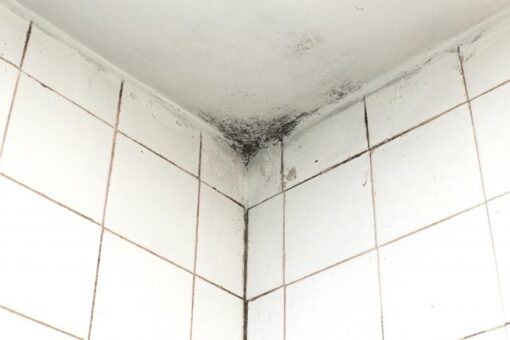
Shower and bathroom mould growth is probably the most common and frustrating tile and grout related problem. Mould is a product of wet, humid conditions. Rooms with poor ventilation provide the perfect breeding ground for mould. Soap residue and body oils also create a food source for mold to grow.
Quite often, mold growth in showers and bathrooms is caused by a leak somewhere in the recess. A small hole in the grout or cracks in the shower corners is likely to cause water build-up and mould growth.
When mould develops in porous grout joints, no amount of scrubbing with heavy chemicals will resolve the problem in any sustained way. In fact, using mold-killing chemicals actually damages grout by disintegrating it, creating a far worse problem.
Difficulty Cleaning / Dull Looking Tiles
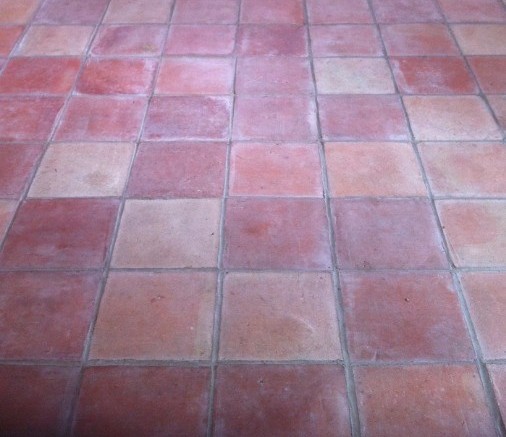
This is a common issue that generally comes from one of several factors. Often it’s because the wrong cleaning products are used.
It is important to seek professional advice as to which cleaning products are right for your particular type of tile.
Another issue has to do with dirt that simply will not come up with standard cleaning products or has been so deeply ground into the porous tile surface that it cannot be removed without causing permanent damage to the tiles. In these cases, tiles have a dull or darkish appearance that simply isn’t attractive. Finally, the use of mops is perhaps the most common mistake used by cleaning crews. Mops simply move dirt around and do not create a clean surface. This has the same aesthetic effect and is generally unsanitary.
Slipping and Falling Risks
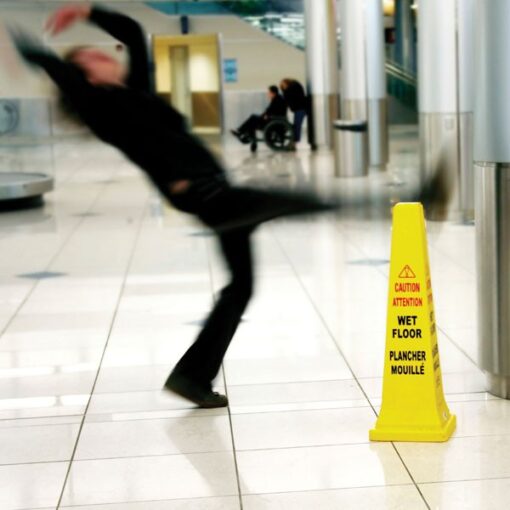
The danger of slip and fall accidents is particularly high on tile floors. In restaurants, bathrooms and anywhere moisture from outside might be tracked in by foot traffic, slip and fall concerns run high. Especially with large tiles, there is a good chance that feet will slide on these wet surfaces and create accidents. This is a huge liability for commercial properties and one that often is not considered until after floors are installed and problems begin to occur.
Talk to one of our Tiletoria sales consultants for the best advice on what tiles to use in commercial spaces, as well as the best grout and adhesives for your project application.